ProAdvisor: Industry-Customizable AI Professional Consultant
📌 Summary
ProAdvisor is an industry-customizable AI consultant for professional advisory workflows where specialist time is scarce and decisions are high-impact.
- Pilot deployment: high-value medical aesthetics services in China.
- Planned verticals: education advising, legal triage, and other expert-heavy service workflows worldwide.
In the current medical aesthetics scenario, ProAdvisor supports two core flows:
- Out-of-clinic concierge: an AI front desk that engages clients online, captures needs and key constraints, guides appointment booking, and produces a structured intake summary for handoff to the clinic team.
- In-clinic advisor: a consultant-side tool that inherits prior records, guides photo and context collection, drafts structured discussion points, surfaces relevant cases, and generates a concise pre-specialist brief.
🧩 1. Product overview
ProAdvisor is a consultant product for professional services teams. Driven by a workflow engine, it distills senior consultants’ methods into configurable dialogue flows, plug-and-play industry knowledge components, compliance and risk boundaries, and expert handoff and collaboration mechanisms. It supports end-to-end delivery from client reception to specialist collaboration, continuously accumulating reusable advisory assets.
It productizes advisory services into deliverable capability modules and crystallizes them into three core capabilities:
- Structured needs capture: transforms natural-language consultations into a structured requirement profile, clarifying goals, constraints, and risk preferences to improve triage efficiency and information completeness.
- Plan drafting and risk prompting: combines the requirement profile with industry knowledge components to output structured plan talking points and risk prompts, improving recommendation quality and communication consistency.
- Expert handoff and routing: compresses the dialogue context into a specialist-ready pre-brief, completing routing and handoff, freeing specialist time and improving collaboration efficiency.
1.1 Industry scalability
ProAdvisor scales via two standardized capability sets that make advisory services reusable across industries and deployable at scale.
- Industry template packs
- Abstract the advisory chain into configurable workflow nodes, scripts, and deliverable specifications
- Help teams execute a unified standard across reception, triage, recordkeeping, and routing, continuously accumulating reusable industry assets
- Organization deploymentplan
- Provide configurable permission systems, audit trails, and risk-boundary controls
- Support unified deployment from small pilots to multi-branch and multi-business-line rollouts, meeting traceable and operable management requirements
ProAdvisor prioritizes advisory scenarios where specialist time is scarce, decision thresholds are high, and compliance requirements are strong. Current focus verticals include:
- Medical aesthetics
- Education planning and advising
- Legal compliance consulting
💡 Medical aesthetics has completed deployment validation, forming a replicable industry template pack and deployment playbook, providing a foundation for replication into other high-ticket advisory scenarios.
🏥 2. First deployed scenario: medical aesthetics
The current version is designed around high-ticket advisory chains, covering a closed-loop pipeline from out-of-clinic reception to in-clinic continuation and then specialist consultation. The goals are to reduce missed leads and repetitive communication, improve conversion and follow-up efficiency, and shorten specialist decision time.
2.1 Out-of-clinic: intelligent reception desk
The out-of-clinic version is primarily self-service, with human customer service stepping in as a fallback. It covers four key stages:
- Friendly conversational reception
- Welcome and basic introduction via a friendly dialogue
- Unify service messaging, reduce communication barriers, and improve trust

- Structured collection of requests and constraints
- Primary concern and desired improvements
- Budget range
- Recovery window and risk preference
- Relevant history and precautions

- Appointment registration and profiling
- Confirm the visit time window and preferred location
- Collect contact details and communication preferences
- Generate appointment intent and a basic profile for ongoing follow-up

- Auto-generate a preliminary communication record and route it forward
- Summarize key information and the likely service direction in a structured form
- Record visit intent, time window, and contact details
- One-click push to the in-clinic consultant workspace for deeper discussion and conversion
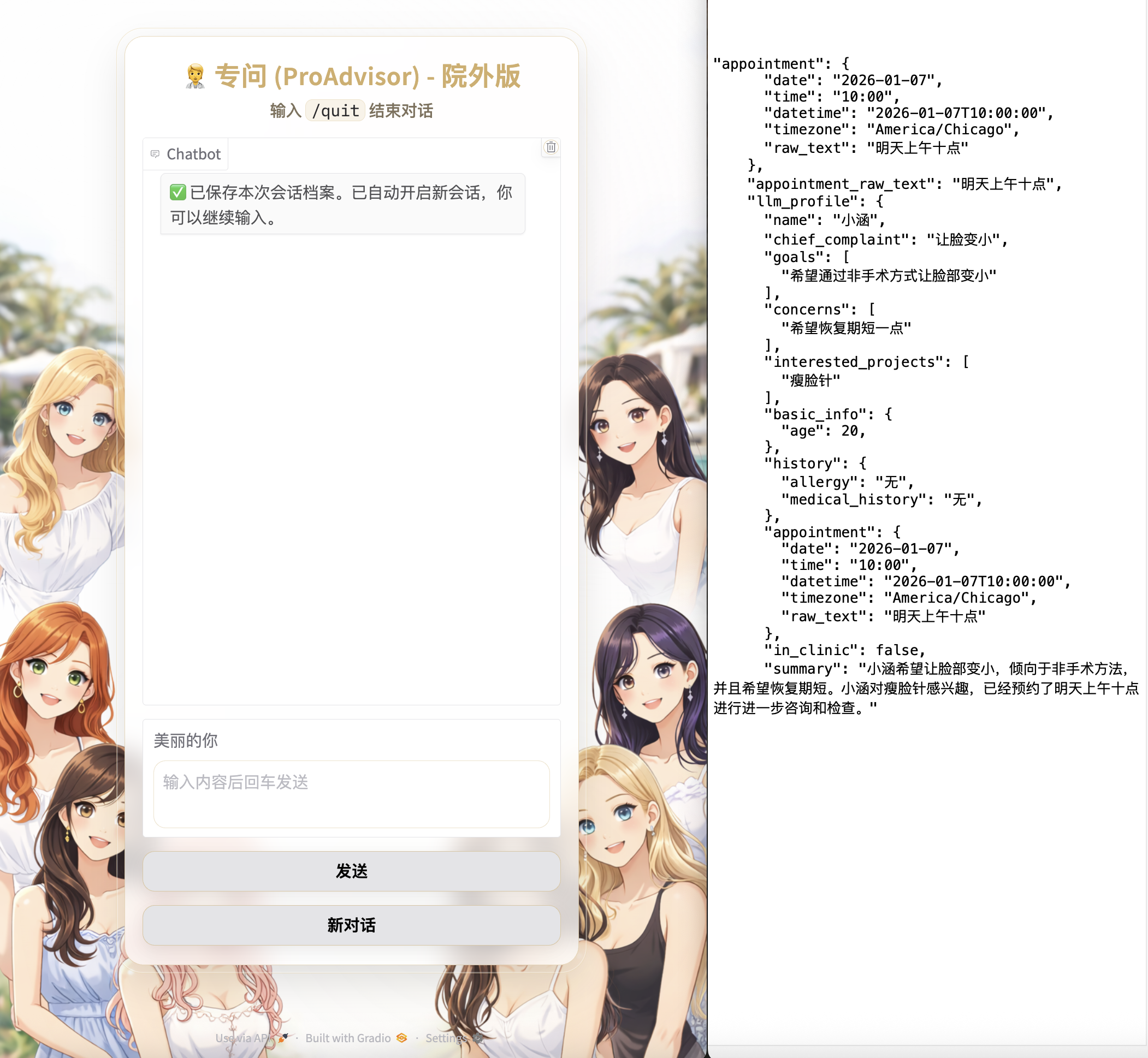
The out-of-clinic version primarily relies on client self-service for reception, request capture, and booking/profiling, while human customer service only intervenes as a fallback at sticking points.
2.2 In-clinic: senior consultant assistant
The in-clinic version is still primarily self-service, with human consultants stepping in as a fallback. It covers five key stages:
- Inherit out-of-clinic materials and start from the key questions
- Automatically ingest the out-of-clinic summary and booking information to avoid duplicate collection.

- Guide supplementary materials and generate plan discussion talking points
- Support uploading client photos and additional context; generate structured talking points based on materials and concerns to help explain plans and risk boundaries.

- Show similar cases to support expectation management
- Retrieve similar cases based on concerns and features to align effect expectations and feasible scope, and to explain differences and risk prompts.

- Generate a pre-specialist brief
- Automatically summarize user concerns, discussed directions, preferences, and key risk prompts in a structured brief to reduce omissions and improve specialist intake efficiency.

- Specialist matching and brief routing
- After selecting the specialist and department, route the brief together with booking information so the specialist can move directly to key decision-making and consultation execution, reducing repetitive Q&A and context backtracking.

The in-clinic version primarily relies on client self-service for information completion and material submission, while human consultants only intervene as a fallback at sticking points.
2.3 Specialist side: key decision confirmation
In the current design, the specialist side remains lightweight, while the preparatory work is completed jointly by the consultant and the system:
- The consultant completes key information during in-clinic discussion and aligns initial explanations and risk boundaries
- ProAdvisor automatically generates a structured pre-specialist brief with booking information, key constraints, and discussed directions
- During the specialist consultation, the specialist focuses on quickly reviewing the brief, confirming risks and preferences, and finalizing the plan and executing the consult
From the specialist perspective, this means clients entering the consultation stage have already completed key upfront information capture and communication, allowing the specialist to focus time on key decisions and execution.
🎥 3. Scenario showcase
- Out-of-clinic scenario
- In-clinic scenario
✨ 4. Core capabilities
From both product experience and organizational operations perspectives:
4.1 Value at the product level
- “Listens”: structured needs capture converts colloquial and ambiguous user expressions into structured requirement elements and key constraints, reducing the risk of missed information and misunderstandings.
- “Explains”: consistent, explanatory outputs organize replies by question clarification, reason explanation, optional plans, risk boundaries, and next actions, improving communication efficiency and service consistency while reducing repeated questioning and misunderstandings.
- “Hands off”: boundary control and low-cost handoff proactively narrows questions that exceed boundaries, makes specialist judgment explicit, and auto-generates a ready-to-use handoff brief, reducing specialist takeover cost.
- “Scales”: multimodal and structured inputs can be incorporated as supporting materials when information sources are clear, improving context completeness (for communication and pre-triage, not as a replacement for professional diagnosis).
4.2 Value at the organization level
- Standardized and replicable advisory flows: distill experience-based service into workflow and script templates, enabling consistent delivery across staff and branches.
- Controllable and traceable conversion pipeline: preserve structured information at key nodes, reducing dropped leads and information gaps, supporting operations follow-up and quality management.
- Free frontline and specialist time: reduce repeated collection and repeated explanation so consultants and specialists can focus on high-value communication and key decisions.
⚙️ 5. Technical architecture
ProAdvisor consists of a workflow engine, LLM capabilities, and an industry knowledge base, designed for controllable advisory delivery processes. It can be decomposed into three layers:
- Dialogue and workflow engine layer
- Manages dialogue state and stage transitions
- Controls the triggering and ordering of key nodes such as questioning, summarization, explanation, and handoff
- Enforces risk-boundary control and escalation strategies, handing over to consultants and specialists when needed
- LLM and expression layer
- Uses a general-purpose LLM as the foundation for understanding and generation
- Through prompt engineering and vertical adaptation, combined with templates and retrieval, and lightweight fine-tuning when necessary, ensures outputs are structured, explainable, and reusable
- Maintains a consistent generation strategy across clarity of expression, risk boundaries, and compliance requirements
- Knowledge assets and organization configuration layer
- Industry knowledge base: concept and service-item explanations, applicability conditions, and precautions (or key risk prompts), etc.
- Case library: anonymized similar cases and comparison materials for communication and expectation alignment
- Organization configuration: specialist roles, departments and service paths, sellable service items and booking rules, etc.
In addition, ProAdvisor supports organization-level permissions, audit trails, and compliance governance for scalable deployment and operational management.
📈 6. Commercial operations
6.1 Target customers
- Professional service teams with high-ticket and high-stakes decisions: long advisory chains, scarce specialist time, and service quality dependent on experience and scripts.
- Chain or group organizations: emphasize service consistency and compliance boundaries, aiming to distill advisory workflows into reusable industry assets and replicate them across branches.
6.2 Business model
- Organization subscription: tiered by branch scale and role seats, supporting pilots through scaled deployments.
- Industry template pack delivery: deliver configurable workflow templates and industry knowledge components for fast deployment and replication.
- Value-added modules: compliance auditing, dashboards, specialist collaboration, etc., enabled on demand.
- Primary bundle: organization subscription plus industry template packs, expanded by value-added modules based on organizational needs.
6.3 Operations and growth playbook
- Benchmark organization pilots: validate the closed loop through pilots, distilling reusable templates and deployment methods.
- Standardized delivery and training system: form delivery packs and training flows to shorten go-live time and reduce delivery costs.
- Channel and ecosystem collaboration: acquire and deliver jointly with channel partners and industry organizations, building a stable acquisition and delivery network.
🧭 7. Future directions
7.1 Product roadmap
- Deepen organization-level deliverable capabilities: support unified deployment from pilots to multi-branch and multi-business-line rollouts.
- Strengthen safety and compliance: cover permission management, audit trails, risk boundaries, and traceability.
- Build an industry template library and knowledge components: improve replication speed and reduce vertical deployment costs.
7.2 Scaling path
- Use industry template packs and organization deploymentplan as core assets to drive cross-branch replication.
- Drive expansion by service consistency, handoff efficiency, and customer satisfaction as key metrics.
- Continuously iterate scripts, workflows, and risk boundaries through the data closed loop.
7.3 Ecosystem partnerships
- Collaboration with channel partners and industry organizations: link acquisition and delivery.
- Connect data and toolchains: build a sustainable, iterative advisory operations closed loop.
✉️ 8. Contact
If you are:
- A medical aesthetics organization or chain professional services team looking to use AI to improve advisory efficiency and service consistency
- An investorfocused on AI-driven digitization of professional services
- A partner interested in collaborating on vertical AI consultant products and industry template packs
Feel free to reach out to exchange product progress and collaboration opportunities.
👤 Founder
ProAdvisor is one of the flagship products of ModelsLive Inc. It was founded by Dr. Yuyan Chen. She received her Ph.D. in Computer Science from Fudan University and is currently a postdoctoral researcher in Computational Biology in the United States at Cornell University. She has long focused on innovation and real-world deployment of large models and AI4Health. Related results have been published in top international conferences and journals, and have received multiple national invention patents.
- Personal homepage: yukyin.github.io
- Company homepage: modelslive.org
- Email: ychen@modelslive.org